Blend Mechanism
Siddharth Lalwani,
Contents
Blend Mechanism
Blend, also known as Blur Lending, is a Peer-to-Peer Perpetual Lending Protocol designed specifically for Non-Fungible Tokens (NFTs). Since its inception on May 1st, 2023, Blend has rapidly established itself as a prominent player in the emerging "NFT-Fi" space. As of now (June 20th, 2023), it commands a significant share of over 90% in the NFT lending market.
In normal circumstances, with fixed-term-borrowing the set up is:
Step 1: Lender deposit funds and signs an off-chain offer, specifying
- Expiration time
- Specified interest rate
- Desired collateral assets (which NFT collections?)
Step 2: A borrower with the NFT
- Choose loan with interested term
- Create a single on-chain transaction to retrieve loan amount and create a lien on their NFT
⇒ If borrower fails to settle the loan within the expiration date, the loan is defaulted ⇒ lender can seize the collateralized NFT.
Lenders bear the risk of NFT price fluctuations. If the price of an NFT significantly declines, borrowers may default on their loans, resulting in lenders experiencing a loss of gap between the lending amount and the value of the NFT. To address this, Blend offers refinancing solutions through Dutch auctions. Essentially, lenders have the option to initiate an auction at any time to liquidate their position. Accordingly, borrowers can choose to repay their debt and explore alternative loan offers.
Dutch auction also offers two implications:
- Expiration time can be extend indefinitely ⇒ perpetual
- Loan terms are settled in P2P manner.
NFT Lending Flow
In summary, a high level overview of the loan flow is:
- Lender place offer through Blur.io UI. Must have deposited ETH into the BlurPool.
- Blur backend (off-chain) aggregate order book data and reveal offers to potential borrowers (NFT owners).
- Owner accept a loan offer by completing an on-chain transaction, effectively starting the loan.
So for lender and borrower:
- Lender: Deposit ETH (on-chain) → sign to create offers → wait for potential borrower
- Borrower: Own NFT → specify loan amount (APY is fetched by Blur) → accept offer (on-chain) → complete loan. (lender got notified on subsequent visit to blur.io)
During Dutch Auction, the rate is non-monotonic. Instead 3 line segments with different slopes are used
Calculations
The adjusted rate coefficient w.r.t to old rate, ,is defined by:
Then the APY rate with time during auction is:
From this analysis, we know at the expiration time, if the borrower has not repaid the debt, a refinancing auction begins at 0%, with a steadily rising rate. Once the auction hits an interest rate at which a new lender is interested in lending, the new lender can accept it by submitting their offer on-chain. The new lender pays the full repayment amount to the old lender, calculated as of the moment the auction completes, and takes over the loan until the new expiration time (which could be calculated as the current expiration time plus some protocol-specified loan period), using the interest rate at which the auction resolved.
Blend Analytics
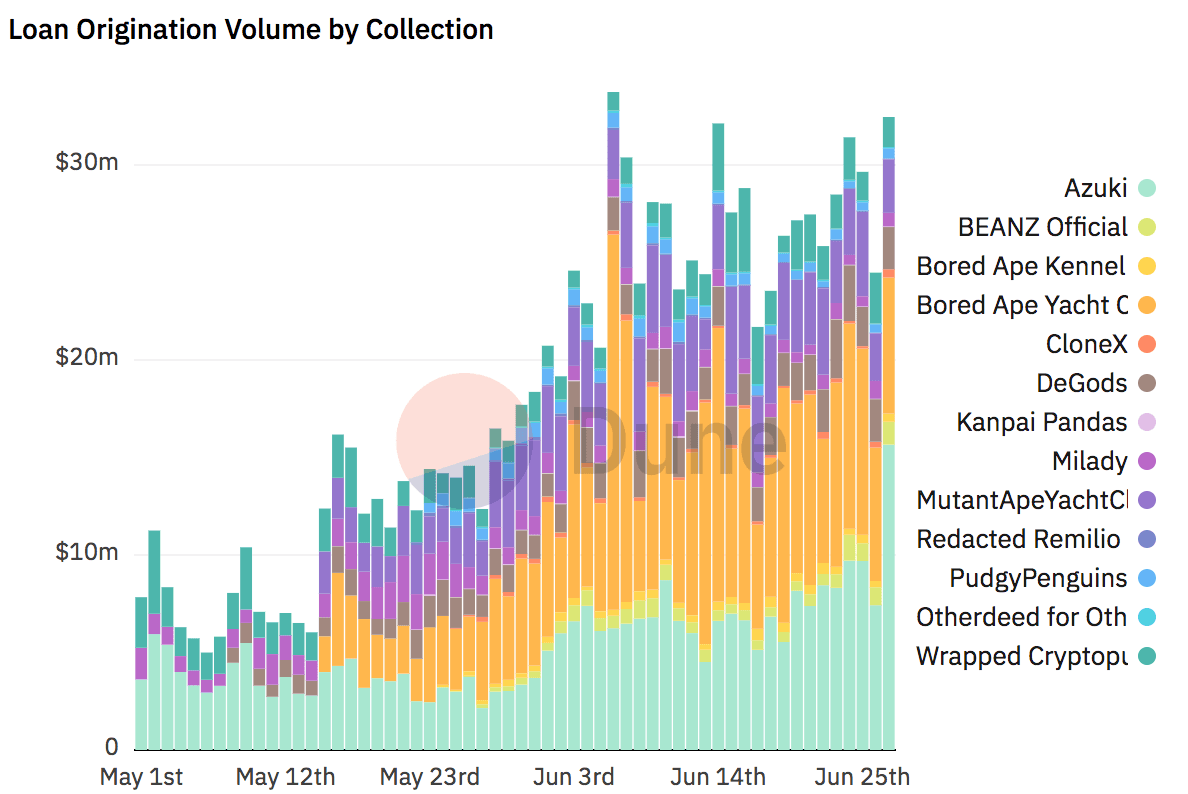
Blend has emerged as a dominant force in the NFT lending market, surpassing significant milestones. According to data from Dune Analytics (source: https://dune.com/beetle/blur-loans) as of June 27, 2023, Blend's cumulative volume has exceeded 1 billion USD, with over 74,000 loans facilitated. Despite being a newcomer, Blend exhibits notable advantages over other NFT lending platforms. Notably, for the week ending June 26, 2023, Blend ranked first in terms of weekly dollar volume, with an impressive 61.5 million USD, followed by NFTFI with 1.8 million USD and BendDao at 1.5 million USD.

Blend currently supports a diverse range of 13 NFT collections. Among these collections, Azuki and Beanz have gained notable popularity among users.
Lending Yield
Range Protocol, being the industry-leading asset management protocol, recognizes the potential for achieving decent returns by providing liquidity in the NFT lending market. As such, Range Protocol is actively researching in this market and has explored two avenues to generate yield: initializing loan offers on the Blend platform and engaging in refinancing to provide liquidity.
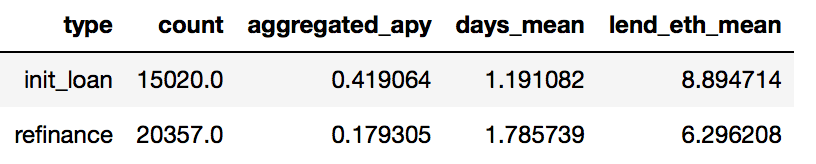
When considering the aggregated_apy that takes into account the duration and size of the loan, it is observed that initializing a loan offer on Blend is more profitable compared to engaging in refinancing. The initial loan option offers a substantial 41% annualized return, while the refinance option yields a lower 17% annualized return.
It is also worth noting that the average loan duration in this context is relatively short, lasting slightly over a day, while the average loan size amounts to 8.8 Ethereum.
Currently, Blend has an excellent early stage incentive plan for loan offers to boost liquidty, which caused numerous zero APY loan offers. However, they typically have shorter durations and involve lending a smaller amount of ETH, making them less risky compared to non-zero loans. Non-zero loans come with a yield premium.

To ensure yield, it is essential that the borrower fully repays the debt (loan+ interest) or replaces it with a new refinancing loan. If the debt exceeds the value of the NFT, there is a higher likelihood of the borrower defaulting. In such cases, you would not receive the yield but would instead seize the NFT as collateral.
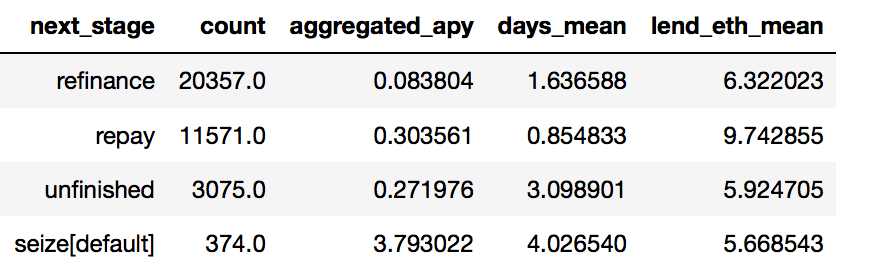
Regarding the table above, while loan defaults are rare, there have been instances where the aggregated_apy for seized NFTs has reached remarkably high levels. This suggests that refinancing or repaying the loan at such high rates may not be feasible or practical.
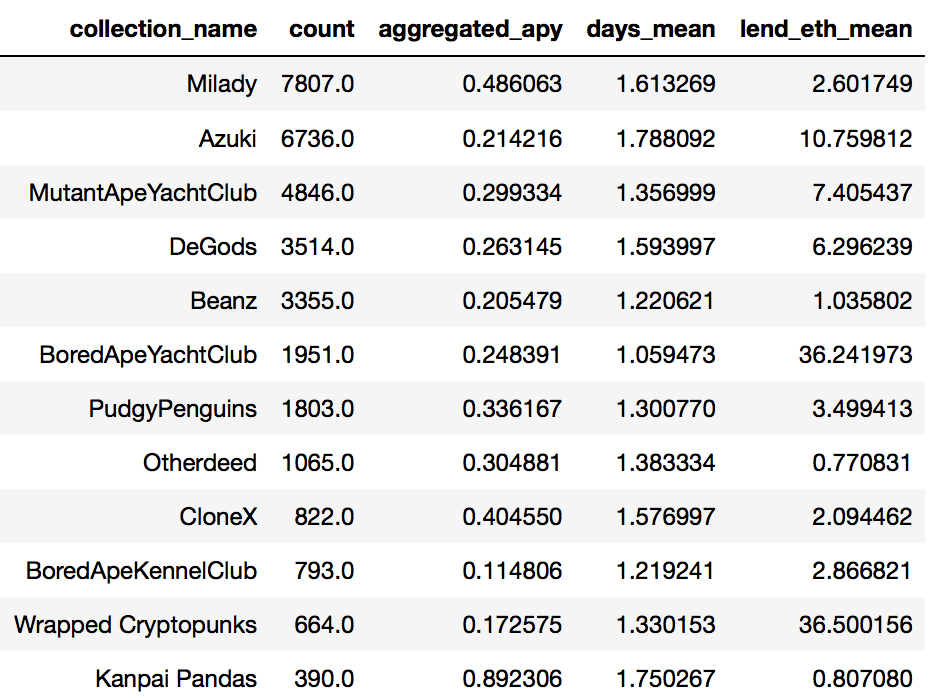
During our analysis, we also examined the duration of loans and found that in some cases, a very short loan duration could indicate a potential wash trade. A wash trade refers to a deceptive practice where the same entity or entities trade with themselves to create an illusion of market activity. Therefore, it is important to consider the loan duration as one of the factors when evaluating the legitimacy and nature of a loan transaction.
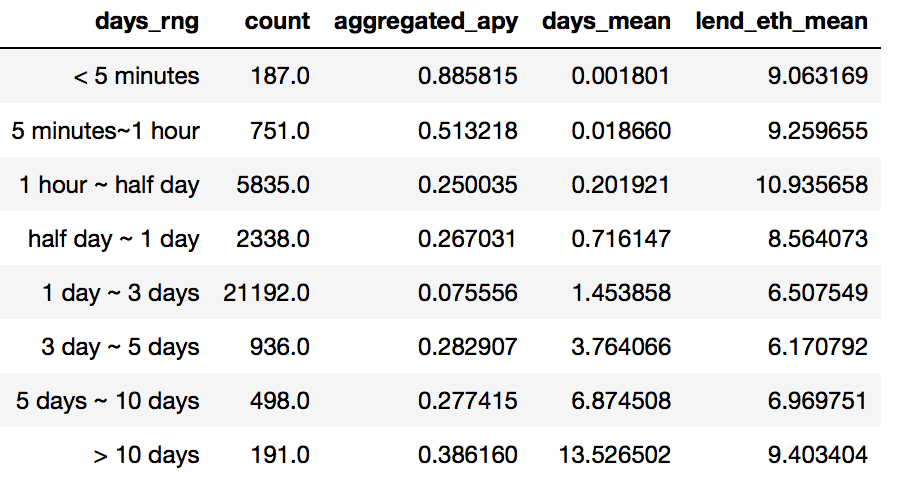
There are small qunatities loan or refinance has a duration within an hour, which is hard to realized real yeild because the time is short plus the gas fee. we should also clarify these cases make insignificant impact for our former analysis since our aggregated_apy is calculated with duration and loan-amount weighted.
Range Strategy On Blend
Offering loans or refinancing on Blend is not without risk, the primary source of risk arises from the possibility that the value of the NFT collateral falls below the debt amount. In such a scenario, there would be no incentive for the borrower to repay the loan or for new participants to join for refinancing.
Monitoring the risk for ongoing loans or refinancing is relatively straightforward. By estimating the NFT price and comparing it to the current debt amount (or the current debt plus a predefined buffer), we can determine whether to liquidate the active loan through a Dutch auction. This is our exiting strategy.
While this strategy is clear for ongoing loan events, it is essential to develop a rigorous model to determine the criteria for entering a loan or refinancing arrangement. To build such a model, we need to make certain assumptions about the NFT price model, as it is the source of the downside risk of the loan.
Let's assume that the individual NFT prices follow a geometric Brownian motion. At time , the underlying price for the NFT, denoted as , can be described by the equation:
where represents the drift term, represents volatility, and represents Brownian motion.
The debt amount at time , denoted as , can be calculated as follows:
where is the initial loan amount, is the applicable interest rate. For simplicity, we will ignore the term in subsequent analyses as it can be merged into the linear term of interest.
The lending yield at time , denoted as , is a stochastic term that can be defined as:
Various criteria can be used to assess this yield. As asset managers aiming to minimize the chance of financial loss, we introduce the probability , defined as:
To analyze this model empirically, we examined existing Blend data. Firstly, we verified that individual NFTs do follow a geometric Brownian motion by analyzing pooled NFT sale data. The distribution of fixed-time range returns is as follows
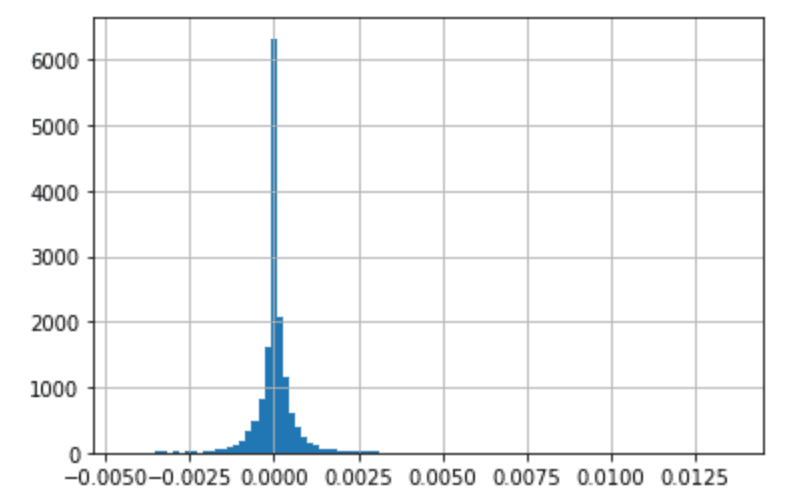
The distribution of fixed-time range returns for individual NFTs resembles a normal distribution but exhibits significant fat tails, indicating the high volatility of NFTs as assets. Based on this distribution, it is reasonable to assume that the drift term () is 0.
When initializing a loan or refinancing offer, two parameters need to be set: the and the ( annual percentage yield i.e interest). It is not advisable to set the higher than the floor price of a specific NFT collection, as borrowers could exploit risk-free arbitrage opportunities by taking such loans and defaulting. However, for participating an existing loan Dutch auctions, the upper bound price is the current fair price of the NFT for refinancing, rather than the floor price.
Although the upper bound price may differ between initializing loans and refinancing, the approaches for evaluating remain the same. Assuming a time period of 30 days ( = 30), we can calculate for any given and . The heatmap for the Azuki collection would resemble:

The y-axis represents , values vary from 0 to 1, and the on the x-axis, which is bounded by the floor price (assuming this is for an initial loan). Darker colors indicate lower values of , indicating lower risk.
Notably, in the bottom right corner of the heatmap, where the is close to 0 and the approaches the floor price, the risk tends to be significantly higher.
As a rule of thumb for our strategy, for both initial loans and refinancing, we can calculate p*t for various combinations of and . By setting a risk limit, such as a losing chance threshold of , we can identify the specific area (yellow area in the following figure) where we can place the loan offer.

While this case study focuses on the initial loan offer, the same methodology can be applied to refinancing by replacing the floor price with the NFT price in the active Dutch auction. Since refinancing typically requires a higher APY than the original offer, we can utilize our heatmap to identify the feasible overlapped area where the refinancing offer aligns with acceptable risk parameters.
In conclusion, offering loans or refinancing on platforms like Blend involves inherent risks due to potential NFT collateral devaluation. Rigorous risk assessment, based on NFT price dynamics and probability analysis, is essential. Setting loan parameters below the floor price prevents arbitrage opportunities. Heatmap analysis helps identify acceptable risk areas. By employing data-driven models and risk management practices, lending operations can navigate the volatile NFT market effectively.